
A friend of mine has had an experience at a nearby military medical facility that made me wonder about the medical standards on base versus off base. My friend was an in-patient in a military hospital last summer with low electrolytes, which can cause confusion (see this article).
My friend spoke to a nurse and the nurse must have told the other nurses what my friend said in her confused state. The next thing you know, a dietician appears and, without telling my friend, diagnosed her with Bulimia. My friend had no idea she had been incorrectly diagnosed.
When asked how the dietician made the diagnosis, it was from “talking to people and blood work.”
NOTE: I didn’t know anything about Bulimia Nervosa (even how to spell it) so it’s all new to me. Bulimia is an eating disorder that is characterised by binge eating followed by throwing up.
My friend had some other issues to deal with and was depressed so they sent her to an on-base psychologist. The psychologist asked if my friend was purging. She thought that was an odd word to use but purging means to clear of something unclean or unwanted. Like purging information from a file. My friend was unaware there is a medical definition of purging: (see http://www.thefreedictionary.com/purging )
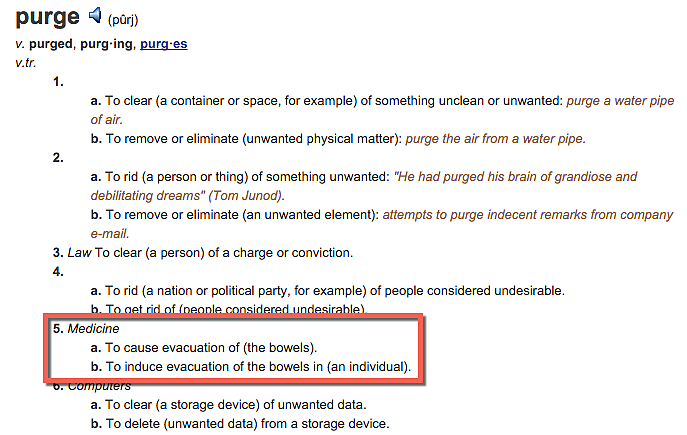
The psychologist was really asking my friend if she intentionally made herself vomit in a confusing way.
NOTE TO PROVIDERS: If you use a word that has other meanings outside of your field, please clarify exactly what you are saying/asking.
The psychologist now thinks my friend has an eating disorder because she said she purges. My friend ran into the psychologist near the base exchange and the psychologist said my friend is Bulimic because she knows ten providers who say that she is Bulimic.
Is that really how an on-base dietician and psychologist make a diagnosis? What other people say? This sounds like water cooler medicine.
My friend asked a Professor Doctor in Psychology off base how to diagnose an eating disorder and she showed a list of questions you have to ask to make that diagnosis. Neither the dietician nor the psychologist on-base asked any of those questions.
My friend didn’t find out that she was diagnosed with Bulimia until she got a copy of her medical records and Bulimia was like a virus, infecting her record.
NOTE TO PATIENTS: Get a copy of your medical records every year. Up to 40% of electronic medical records have errors. It’s important!
Naturally my friend was very alarmed that she had this diagnosis in her medical record so she’s been trying to have it removed. She first went to her German doctor for a second opinion.
The German doctor said he was not qualified to make a diagnosis of Bulimia. Only a Psychiatrist can. So my friend went to a Psychiatrist off base and he said even if you told him you were Bulimic, he couldn’t believe you. He would have to observe you for one to two weeks in-patient to make a proper diagnosis.
When the off-base Psychiatrist was told that a dietician and psychologist made a diagnosis of Bulimia, he couldn’t believe it. His recommendation was not to use the base medical facilities and to get an attorney.
Another friend who was in the German Polizei said according to European Law, only a Psychiatrist can diagnose a patient with Bulimia.
So we have two different standards apparently.
- At the military hospital, a dietician and psychologist can diagnose Bulimia by talking to you and maybe use a blood test.
- Off base, only a Psychiatrist is qualified to make a diagnosis of Bulimia.
Draw your own conclusions from this story about where you want to receive medical care. Active Duty don’t have a choice. Dependents and retirees do!
Don’t forget to get a copy of all of your medical records regularly. There are three types of records:
- Out patient
- In patient
- Behavioral Health
NOTE: A behavioral health provider can block you from getting your behavioral health records, but according to HIPAA, the provider has to provide you a reason of why they are blocking your access to your records.
Outrageous things like this don’t always happen to someone else!
Have you had any bad experiences with your local military health providers? Leave a comment below!

Leave a Reply